There’s a lot of new technology entering the market, and when used well it can provide valuable insights into trapping and pest control.
I’m a strong advocate for technology that makes monitoring easier, and few tools do this better than Cacophony Project cameras. They’re significantly more accurate than traditional trail cameras, with data automatically uploaded and classified. While they cost more, they save substantial time and effort.
I use Cacophony cameras in two main ways:
- Monitoring plots
Cameras are placed at predefined plots for a set period (10 days in my case) to benchmark predator numbers before control begins. Repeating this at the same time and location in future years allows direct comparison. I’m not aware of a more accurate benchmarking method. - Observation
This includes understanding animal interactions and counting animals when testing traps, baits, or lures. While thermal cameras aren’t ideal for detailed trap interaction (traditional trail cameras give clearer images), they excel at automated detection and population trends, making them ideal for testing hypotheses.
Cameras are also effective for proof of absence, as they’re more accurate than traditional cameras and can send notifications when animals are detected. Some 4G trail cameras offer this too, but generally with lower accuracy, highlighting the trade-off between cost and precision.
Example:
At one monitoring plot, cameras showed ongoing possum and rodent activity despite trapping. With limited trap success, a Brodifacoum-based rat bait was deployed in a 50m grid using 200g bait stations. Within a month, camera detections of rats dropped to near zero. Initially this seemed like a camera fault, but other small animals were still being detected—the rodents had genuinely gone (blue on the graph).
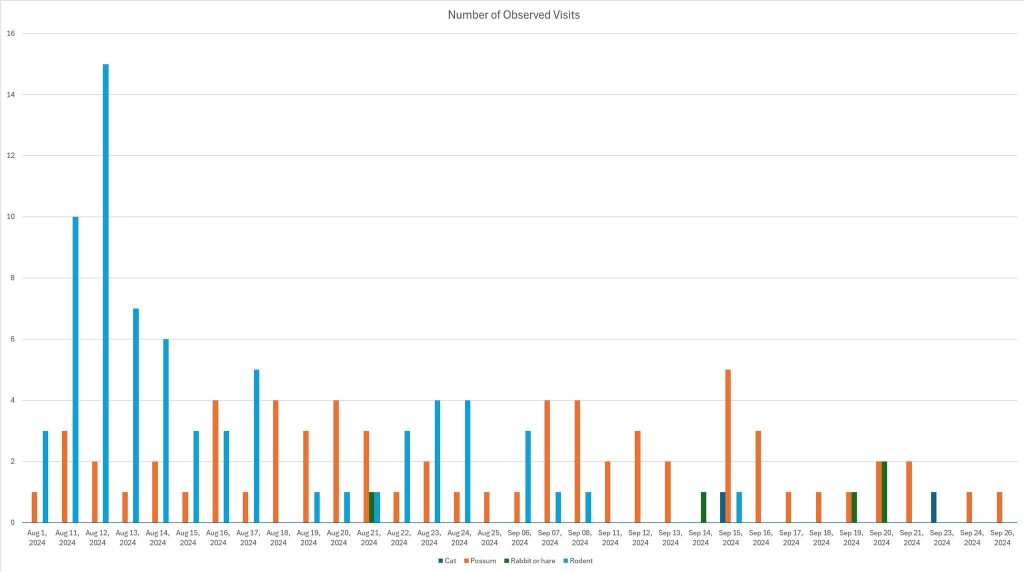
Two key learnings:
- Internet-connected thermal cameras provide near real-time, low-effort monitoring and clearly show the impact of control work.
- The toxin was more effective than expected, with rodent populations collapsing.
Most importantly, automated camera data allowed us to visualise the impact of toxin use and confirm that trap-shy animals were removed quickly—raising the question of whether toxins should have been used earlier, or instead of traps!
A few closing points:
- Traditional trail cameras are low-cost and effective, but require manual data handling. Browning Dark Ops Pro are low cost, and pretty effective.
- 4G cameras are relatively affordable, upload images with notifications, and are compact, but are typically infrared and less accurate for predator control than Cacophony cameras. WiseEye DataCam DC-2 are still pretty cheap ($500ish) and have reasonable data plans.
The goal here isn’t to compare technologies in detail, but to show how using the right tools can help us better understand our environment and the impact of our actions. Technology is the enabler, not the solution – how we use it and what we learn from it is the real game changer.